
Khaleda Zia, the former Prime Minister of Bangladesh and a dominant figure in the country's politics, has died at the age of 80 after a prolonged illness. Her career spanned decades and included periods of both power and controversy.

For India, the guiding principle should remain clear: Engage Bangladesh as a sovereign nation and society rather than through the prism of any individual leader or political party, suggests Manoj Mohanka.

Seven-time champions India are strong favourites against Bangladesh in the Women's Asia Cup semi-final. The match carries an underlying political subtext, adding to the intensity. India's dominant form, led by Smriti Mandhana and Shafali Verma in batting and Deepti Sharma and Renuka Singh in bowling, contrasts with Bangladesh's more resilient path to the semi-finals.

India's Ministry of External Affairs spokesperson Randhir Jaiswal stated that India desires positive, constructive, and forward-looking ties with Bangladesh and is ready to discuss all bilateral issues. This comes amidst queries regarding the state of relations following a change in Bangladesh's government and upcoming international engagements.

Bangladesh-China and Bangladesh-US relations have evolved from reluctant engagement to increasingly consequential strategic partnerships.

Veteran politician Mirza Fakhrul Islam Alamgir has been sworn in as Bangladesh's 23rd President, following a contested parliamentary election that saw him defeat Colonel (retd) Oli Ahmed. Alamgir, a longtime secretary general of the ruling Bangladesh Nationalist Party (BNP), will serve a five-year term.

Mirza Fakhrul Islam Alamgir, secretary general of the ruling Bangladesh Nationalist Party (BNP) and a close ally of former premier Khaleda Zia, has been elected as Bangladesh's new President in the first contested poll for the post in 35 years.

Bangladesh has not yet decided on Prime Minister Tarique Rahman's visit to India for the upcoming BRICS summit, with his office stating that Dhaka is awaiting New Delhi's response to its request for the extradition of deposed prime minister Sheikh Hasina and other 'fugitive criminals' currently residing in India.

'After announcing that she will return to Bangladesh, if she does not, her credibility will suffer.'

Tarique Rahman is Bangladesh's first male prime minister in more than three decades, ending an era of female leadership that began in 1991.

India is currently examining Bangladesh's request for the extradition of former prime minister Sheikh Hasina, who has been living in India since her government's collapse in August 2024, with New Delhi confirming the issue is being processed according to established procedures.

Former Bangladesh cricket captain Shakib Al Hasan's ancestral home was attacked with petrol bombs and smashed windows after he participated in an online media interaction where ousted Prime Minister Sheikh Hasina vowed to return to Bangladesh despite facing a death sentence.

Bangladesh on Wednesday expressed outrage over deposed prime minister Sheikh Hasina's media interaction in New Delhi, saying the event has hurt the sentiments of its people and could adversely affect efforts to improve bilateral ties with India.

Bangladesh has once again sought the extradition of former premier Sheikh Hasina from India during High Commissioner Dinesh Trivedi's first meeting with Prime Minister Tarique Rahman in Dhaka, amidst fresh strains in ties between the two countries following Hasina's controversial virtual media interaction in New Delhi.

Refusing to travel to India citing "sensitive bilateral situation", Pakistan on Wednesday asked the Asian Hockey Federation to shift its Asian Champions Trophy matches to a neutral venue.

Bangladesh's High Court has granted bail to Hindu rights leader Chinmoy Krishna Das in two cases, though he remains in prison due to four other pending charges, including murder and treason. His arrest in November 2024 on sedition charges had sparked protests and communal tensions, drawing concern from India and occurring amidst strained India-Bangladesh relations following the ouster of Prime Minister Sheikh Hasina.
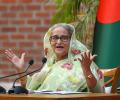
Former Bangladesh Prime Minister Sheikh Hasina has declared her intention to return to Bangladesh in December, despite facing a death sentence and the risk of arrest. Speaking from India, she stated her goal is to restore democracy and justice, criticising the current state of affairs in Bangladesh and alleging that her government's collapse was due to organised violence. Her son also claimed Bangladesh is a "failed state" and a concern for India.

The Afghanistan Cricket Board and the Board of Control for Cricket in India have confirmed that Afghanistan will host India for a three-match T20I series at the Arun Jaitley Cricket Stadium in Delhi next month.

Bangladeshi cricket legend Shakib Al Hasan, an ally of ousted PM Sheikh Hasina, is willing to return from exile in the US to face charges, including murder, if the government guarantees his safety. He hopes to play a farewell series and represent Bangladesh in the 2027 World Cup, highlighting the challenges faced by Hasina's allies after her government's fall.

India's national security adviser was in Dhaka for roughly three-quarters of the day on Thursday to prepare the ground for Bangladesh Prime Minister Tarique Rahman's visit to New Delhi.

South Korea's men's hockey team faced confusion when organisers mistakenly played North Korea's banned national anthem before their match, compounding earlier complaints regarding organistional issues at the Asian Games.

India's position appears to be anchored around three red lines: Hasina's safety and the guarantee of a fair trial; assurances that Bangladeshi territory will not be used for activities hostile to India; and the restoration of an inclusive democratic process in Bangladesh.

Dinesh Trivedi's success or failure in this fragile diplomatic equilibrium will have consequences extending well beyond the Indian high commission in Dhaka. It will shape India's eastern strategic environment for years to come.

Hasina expressed a desire to face consequences on her home soil, where her parents are buried, amidst repression against her party workers.

Who is running the show in Dhaka? This kind of flip-flop, culminating in a last-minute decision to skip a maiden visit, can happen only when the remote is in the hands of one of the competing lobbies within the BNP -- one that appears determined to play a game of chess with India.

Court said state machinery prevented woman from challenging Foreigners Tribunal order; directs authorities to try to locate her in Bangladesh and bring her back to India.

Pakistan has requested the Asian Hockey Federation to move its Asian Champions Trophy matches from India to a neutral venue, citing a "sensitive bilateral situation" and security concerns. Hockey India has rejected this demand, stating there will be no change in venue for the tournament scheduled in Mohali and Jalandhar from October 27 to November 5. Pakistan's participation remains uncertain, with potential replacements like Bangladesh and Oman being considered.

Dinesh Trivedi's experience as a businessperson and his fluency in Bengali are expected to be crucial in strengthening India-Bangladesh relations, particularly in attracting Indian investments to Dhaka.

Japan is deepening its defence relationship with India while simultaneously expanding its economic, infrastructure and security engagement with countries around India -- particularly Bangladesh. The result is an emerging Japanese conception of South Asia in which India remains the strategic anchor, but the geography surrounding India is becoming increasingly important, points out Varun Arya.

Prime Minister Narendra Modi's 76th birthday was marked by a flurry of greetings from global leaders, including Italian PM Giorgia Meloni, Israeli PM Benjamin Netanyahu, and Russian President Vladimir Putin, all underscoring strengthening bilateral ties and India's increasing stature on the world stage.

West Bengal BJP president Samik Bhattacharya's comments recalling the role of non-Bengali communities during the 1946 communal riots and alleging past restrictions on Durga Puja have drawn sharp criticism from opposition parties, including the TMC, Congress, and CPI(M). Bhattacharya appealed for unity for peaceful Durga Puja celebrations, while opposition leaders accused him of divisive politics and distorting history.

Dhaka and Beijing on Thursday agreed to strengthen cooperation on the management of the Teesta and other rivers and signed 13 agreements to bolster bilateral ties following talks between Bangladeshi Prime Minister Tarique Rahman and Chinese Premier Li Qiang.

'They probably imagine any hue and cry in the event Sheikh Hasina is hanged will be shortlived as it happened when Bhutto was hanged in Pakistan in 1979.'

Exiled Bangladeshi author Taslima Nasreen has drawn a parallel between the CJP-led protest in Delhi and the 2024 student movement in Bangladesh that ousted Sheikh Hasina's regime, warning that the Bangladesh stir 'fooled us' and was ultimately taken over by 'jihadis'.
A parliamentary committee has noted Bangladesh's extradition request for former prime minister Sheikh Hasina, who faces a death sentence in absentia. The Indian government has confirmed the request is under examination, reiterating its humanitarian approach of offering refuge while ensuring no political activity is conducted from Indian soil. The committee has urged the government to keep it apprised of the matter.

Bangladesh summoned India's Deputy High Commissioner to convey "deep disappointment" after Dr. Zahed Ur Rahman, an adviser to the Prime Minister, was stopped and questioned by immigration authorities at Delhi's Indira Gandhi International Airport. The incident led to Rahman's decision to return home despite being cleared to proceed.

The question for the next 20 years is not whether India can become a $5 trillion or $10 trillion economy. Those are attractive targets, but the real question is whether India can create enough productive jobs, educate its children properly, make its cities liveable, and give hundreds of millions of people a substantially better life, asserts Ramesh Menon.

Former Election Commissioner Ashok Lavasa has strongly criticised the ongoing special intensive revision (SIR) of electoral rolls, labelling it an 'unfair procedure' despite its legal standing, raising concerns about mass voter deletions and the erosion of democratic trust.
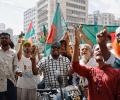
Bangladesh is preparing for elections and a referendum on reforms, but the absence of the Awami League and rising political tensions are raising concerns about the legitimacy and stability of the process.

Former Army chief General Manoj Naravane asserted that while India's immediate attention is on Pakistan due to terrorism, China will be New Delhi's primary long-term competitor across political, economic, trade, and military domains, necessitating a strong military deterrence alongside dialogue.
